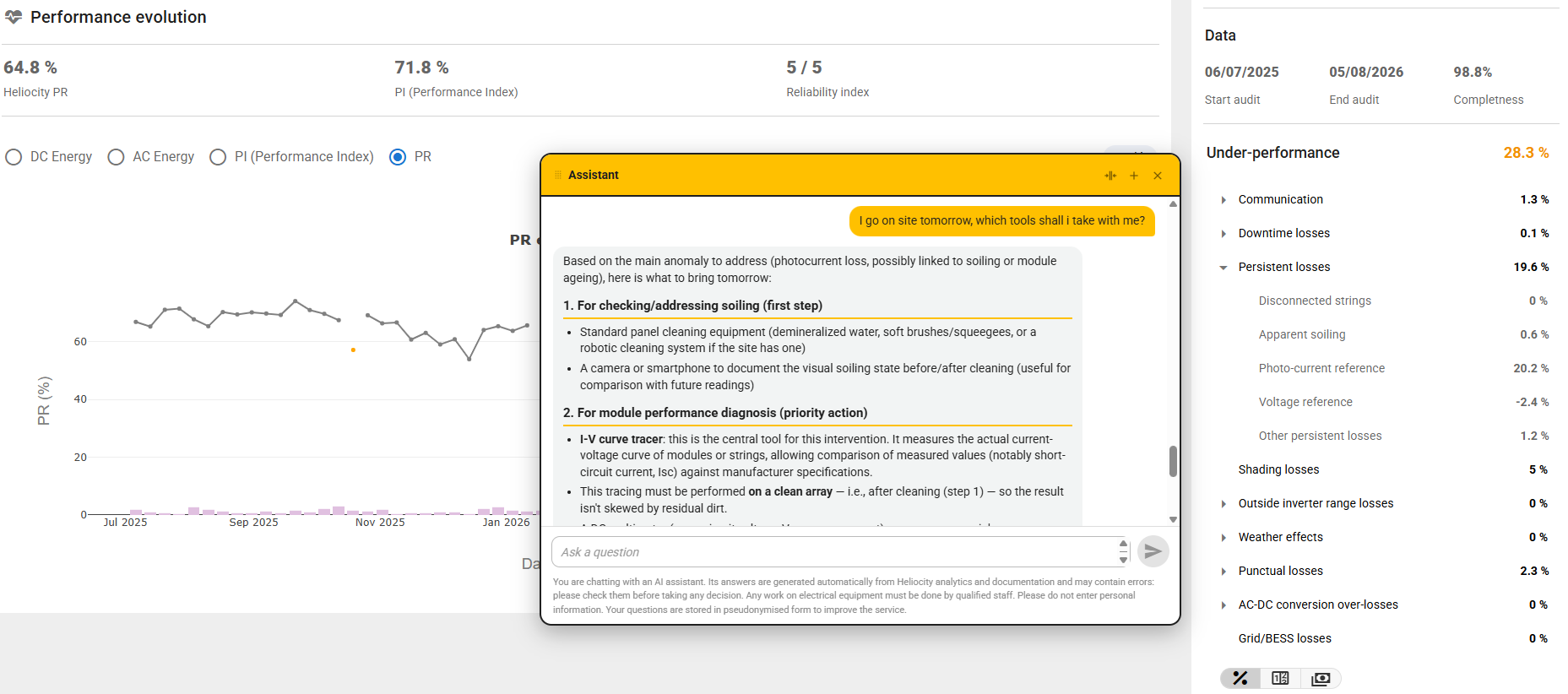
As part of the COSMIC programme, Heliocity has just reached a key milestone in Challenge 12: the two applications developed this year are now open to beta testers at our two pilot sites, in France and Portugal. The most visible to the user is an AI-based conversational agent, which transforms a performance audit into a clear assessment and concrete actions.
The problem is no longer detecting — it is understanding
Heliocity’s photovoltaic performance analytics can now detect many things: underperformance, anomalies, probable causes, associated losses. The result is a dense diagnosis — dozens of loss items, percentages per measurement point, signatures to interpret. Turning it into a maintenance decision requires expert time.
That is precisely the time that asset managers, operations technicians, local authorities and energy communities running plants today lack. A complete but unreadable audit report produces no action.
What the agent does
From a plant’s analytics results, the agent automatically generates a summary of its state of health, the list of detected anomalies ranked by severity and urgency, the recommended preventive and corrective actions in the order in which to carry them out, and the estimate of the corresponding energy losses.
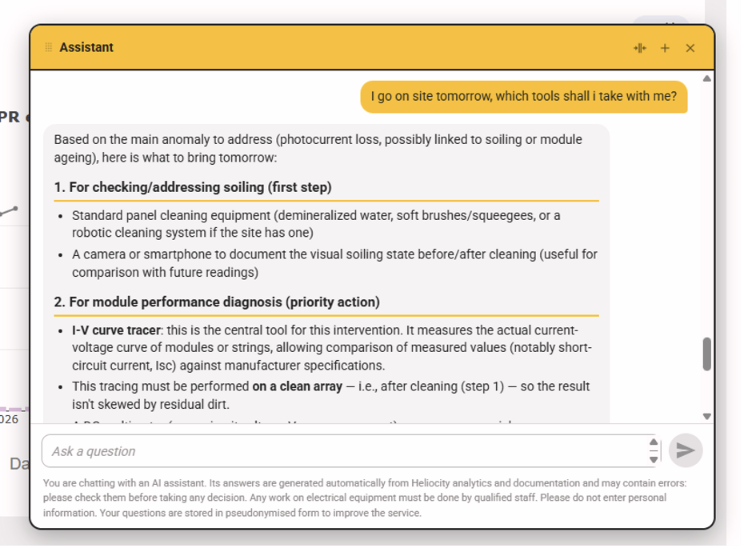
Above all, the user can continue with a conversation. Why this anomaly? Is there an alternative to the proposed action? What happens if I do nothing this year? The answers adapt to the profile: the same finding is not expressed in the same way for an engineer and for a non-specialist operator.
An AI built around what it must not say
An agent that talks about maintenance commits to decisions that cost money. We therefore built it around a simple constraint: it asserts nothing that is not established by the plant’s data.
Findings come from our expert rules and the audit measurements, never from the model’s intuition. A comparable case drawn from our knowledge base can illustrate a finding, never replace it — and no third-party installation is identifiable in it. When information is not available, the agent says so instead of producing it.
A concrete example. A current deficit observed over an annual average does not allow the conclusion that modules are aging: it could just as well be soiling present from the start of the period. The agent will therefore never rule on this basis alone. It will first recommend checking the soiling condition of the array, then an I-V measurement on a clean array — the only solid basis for invoking, where applicable, a manufacturer’s warranty. It is this discipline that makes the difference between a useful assistant and a plausible text generator.
Where we stand
The agent was validated on a corpus of real audits reserved for this purpose, through a structured test campaign covering the quality of the answers, robustness against ambiguous or out-of-scope questions, and the absence of unsubstantiated claims. It is now deployed on our platform and accessible to the first beta testers, alongside our second module: the automatic verification and completion of a plant’s descriptive data, which guarantees the reliability of the diagnosis inputs.
What comes next
The coming weeks will be devoted to training the beta testers, followed by a trial period on their own installations. Their feedback will feed into the final version and the deployment model of these two features.